
A snow cave as a tent?
During winter adventures, the topic of building a snow cave or igloo often comes up. In emergencies, these are known as the last refuge against the cold winter night. But can a snow cave also serve as an everyday tent? The short answer is yes, provided you set aside at least 1 to 2 hours to build it.
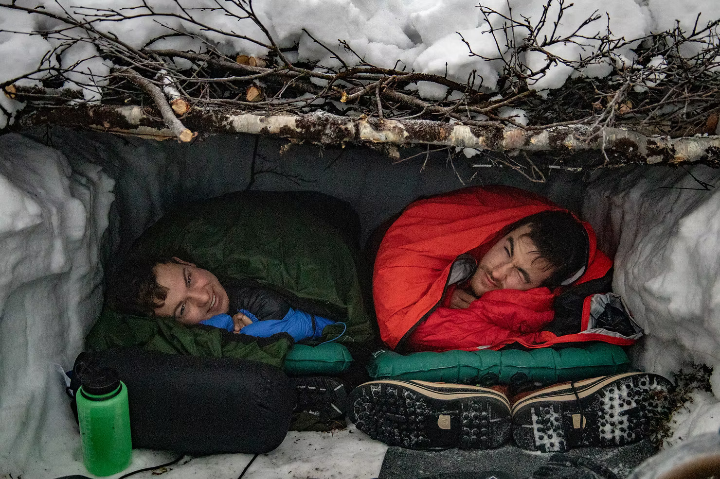
Safe on winter adventure
A snow hole is not a substitute for your backpack. Going on an adventure in winter conditions can be dangerous and requires careful planning and experience. Do not use this description as a replacement for a hut or tent. We advise against the use of snow holes unless you are under supervision and have permission from experienced guides. Here you will find more information about safety during winter snow adventures.
The different types of snow holes
In case of emergency, we have three situations to choose from:
Hell with enough snow – the den (the cave)
Flat area with sufficient snow – the tunnel
Insufficient snow – the hill (mound)
As base camp
Here we prioritise comfort and space to "live". For this construction, a sufficient snow depth is required and building takes more energy. However, the result is a pleasant stay. The starting point is a tunnel or a trench.
The igloo
Use this option if you need to work with ice or hard snow and digging is not an option – or just for fun, as an igloo looks charming. This shape has the steepest learning curve.
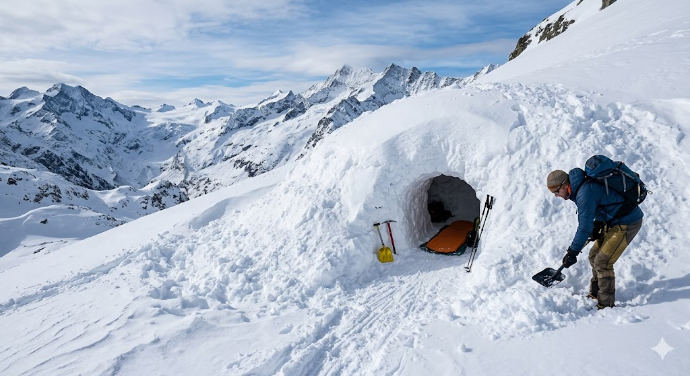
The comfort of a snow hole
When you think of a snow cave, warmth and comfort are not the first things that come to mind. Yet, this is exactly what snow caves provide.
Snow is an excellent insulator, which means your night will be very quiet. A well-constructed snow cave is at least as warm as a tent and can even become too warm.
How do we make our snow hole comfortable?
Warm air rises and heats the snow on the ceiling, causing it to melt and form droplets. These droplets can completely soak you. However, this can easily be prevented by creating a smooth ceiling and providing a ventilation opening.
Our experience shows that sleep and nutrition are very important for the quality of your experience. To sleep well, you don't want to slide off your mat at night or have to avoid a bump underneath. Make sure you can lie completely horizontally along your entire body length.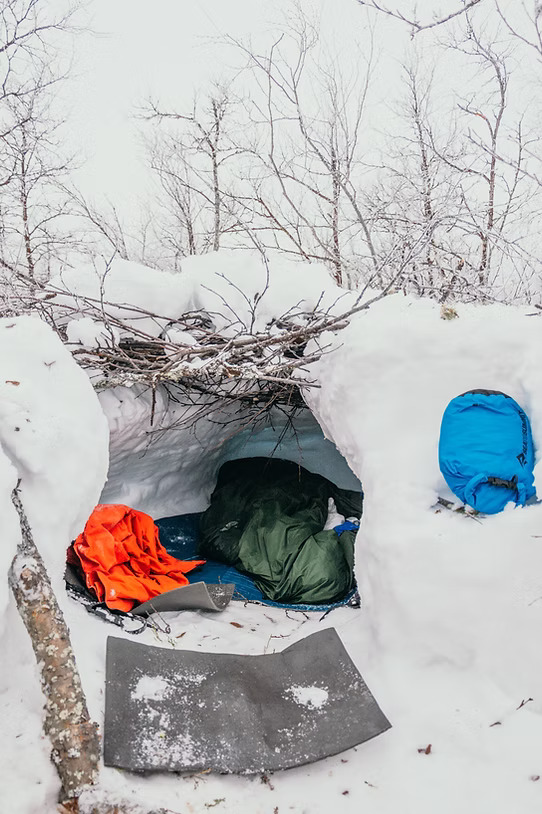 A snow hole can quickly surpass the comfort of a tent.
To gradually expand your comfort zone, you can start with a half-open snow hole (in good weather), or a snow hole that is covered with your pulk (sledge) instead of snow. It is not advisable to have your first experience lying directly with your head two metres under the snow.
The coldest air is heavy and sinks to the lowest point in your surroundings. Therefore, make sure that your "bed" is not at the lowest point. By creating a "cold trap," you provide the coldest air a place to settle.
This is literally a pit at the entrance of your shelter. You create luxury yourself. You will be amazed at what you can achieve with perseverance and logical thinking. For example, it is better to allow some extra space to lie down; at first, you can easily underestimate how much space your mat and sleeping bag actually take up. The same goes for a flat surface: it is better to be precise than careless..
The strength of snow during the day
(This information must not be used for avalanche risk assessments or other hazards.)
Both wet and dry snow become harder as it gets colder. You work with snow when it is at its warmest and therefore at its weakest. As the night progresses, your construction becomes increasingly stronger.
Personal experience
In our quest to explore the limits of snow roofs, we once managed to make one collapse. This happened with a roof that was only 5 to 10 cm thick over a width of 1.2 metres. At that thickness, the snow weighs so little that you hardly notice anything happening, but suddenly you find yourself outside. The collapse occurred while we were making the roof thinner by scraping snow off the ceiling.
With a minimum roof thickness of 20 cm and the use of exclusively round shapes, we can always stand on the roof with snowshoes. In the morning, after spending the night in a snow cave, we often find it a fun challenge to jump on the roof to test its strength – a nice confirmation of the durability of the snow.
Building a snow cave
Choose a location
In a snowy landscape, there is more snow in some places, while in other areas there are obstacles or less snow. Use a probe or a long, thin stick to determine the most suitable spot. This will allow you to measure the snow depth and detect rocks, small trees, or other obstacles. This way, you can avoid starting to dig in a place where there is insufficient space for your construction.
Graven
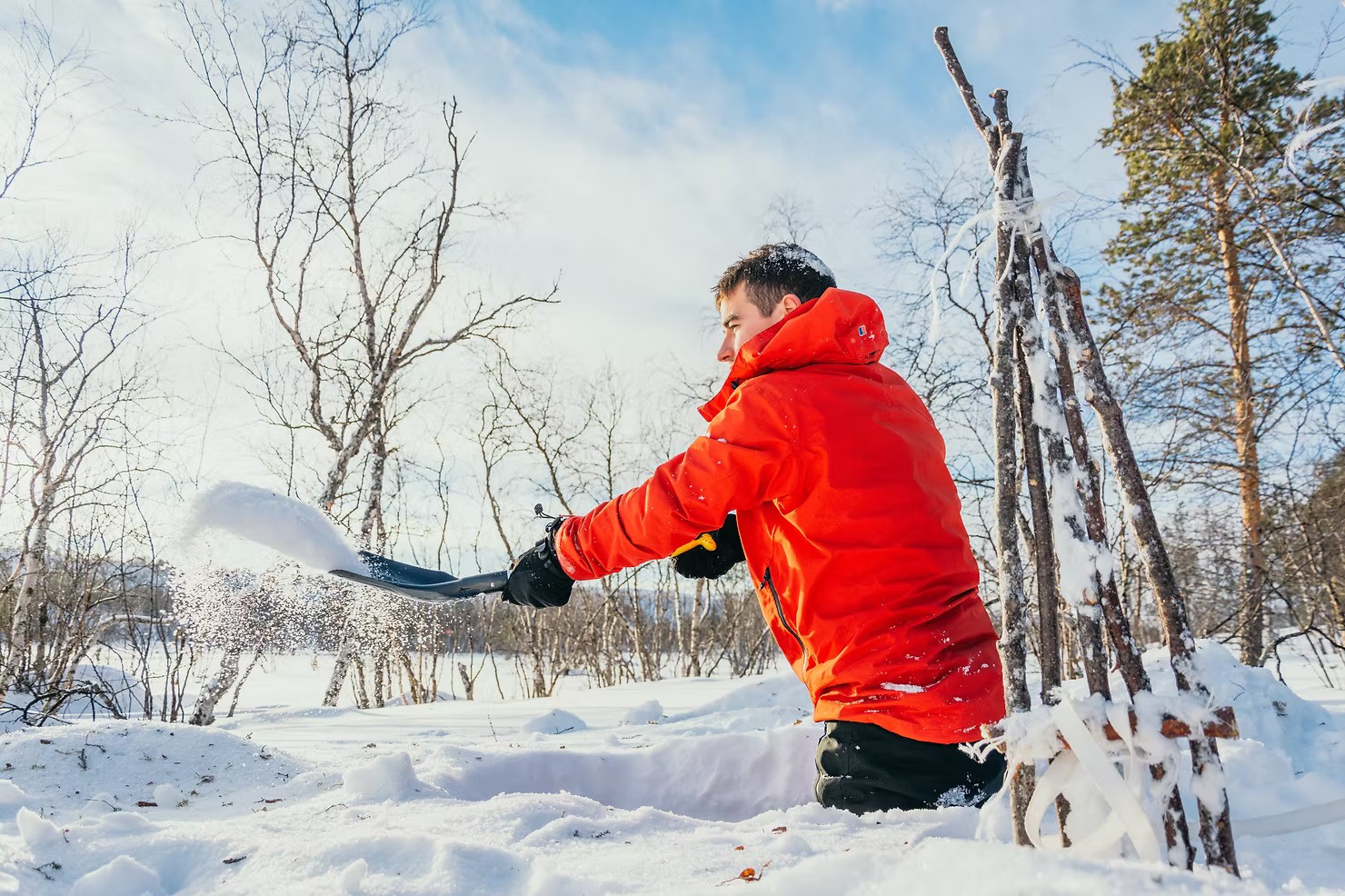
The most important thing is to regulate sweating; therefore, alternate regularly between digging and resting. One person can dig while the other rests. This way, it takes about two hours to build a shelter for two people.
Try to work by forming blocks that you can then throw out of the snow hole. The person resting outside can stack these blocks or simply push them aside.
Cutting blocks
To create a roof for your tunnel, to reduce the size of your entrance, or to build a structure, we use blocks of snow or ice. Try to find a good ratio between thickness, width, and length for these blocks. Approximately 10 cm × 40 cm × 60 cm is ideal for easy handling. The possibilities, of course, depend on the type of snow.
Ventilation opening
First, ensure a smooth finish so that no droplets form on unfinished surfaces. Create a hole to the outside to allow warm air to escape from the top. If you do not do this, you are guaranteed to get wet during the night.
For thin roof layers, a branch or walking stick is sufficient to make the hole. Is the hardness or thickness of your roof a problem? Then you can always use a pot of boiling water as a "drill." Pour the boiling water on the spot where you want to make the hole. On average, one litre of boiling water can penetrate about one metre of snow. Make sure that no one is underneath the shelter and that no one is exposed to the boiling water.
Preventing collapses
Keep your roof at least 20 cm thick and use rounded shapes for the walls and ceiling. After sunset, the surroundings cool down quickly, making your snow cave safer. Therefore, always carefully follow the principle of minimal roof thickness and a rounded structure to prevent the risk of collapse.
Challenge yourself in the wilderness of the far north: build your own snow cave, experience the silence of endless snowfields, and embark on an unforgettable winter adventure. Set out and let the adventure begin!