
How do I buy a raincoat?
If you already know some key terms and the basic principles of raincoat technology, you can navigate below in the article to the coat that will keep you dry - and the coat that fits within your budget.
As for the price, you pay the big brands for all the developments, the testing - and ultimately the performance of the fabrics in the coat you buy. A high-quality raincoat can cost several hundred euros, so researching beforehand is a smart move.
Waterproof vs. water-resistant
We call a jacket "waterproof" if the waterproofing is sufficient to keep heavy downpours out. Although companies do not agree on the testing standards, you can trust that any jacket labelled "waterproof" by a major brand can withstand a serious rain shower.
Waterproof/breathable
This type of rain jacket ensures that the rain does not penetrate to the skin, while sweat is drawn away to the outside of the jacket. If you are planning an activity where you will be very active and are likely to sweat, this is the gear you need. Both precipitation and perspiration can cause your clothing under the jacket to become completely wet, something you always want to avoid.
Water-repellent
This is a raincoat that can handle light rain for a short period. Windbreakers and ultra-light jackets often have a water-repellent coating. If the precipitation persists, then this clothing is not up to the task.
Waterproof/non-breathable
Think of a poncho for emergencies. If you just need to keep the rain out while sitting or standing, this gear does the job well - and it costs relatively little money. But if you exert yourself, the raincoat will quickly become wet inside as well. And it doesn't take much wind to make a poncho largely useless.
Windproof versus wind-resistant
Just as "water-resistant" relates to "waterproof", "wind-resistant" becomes "windproof" when the test results exceed a certain threshold.
Windproof
Every waterproof jacket is also windproof. This makes sense when you consider that a barrier designed to keep out driving rain also blocks the wind that drives the rain. There are also jackets with windproof technology, usually a type of laminate, that are only considered water-resistant.
Wind-resistant
Essentially the same as a waterproof jacket, but this is often an ultra-light garment that can easily be packed into a small pocket. Made for short trips and optimistic weather forecasts, it will not provide much protection in a full-blown storm.
3-in-1 coats
A step further than a raincoat, this design combines a raincoat with a fleece lining. The inner component is usually zipped into the raincoat, allowing you to wear both parts separately.
Types of shells
Although the word "shell" is often used interchangeably with the word "jacket," it can also refer to trousers, parkas, and ponchos. It is a term that focuses more on the fabric composition than on the clothing style. Familiarising yourself with the following types of shells will help you choose protection against rainy weather.
Hardshell
This is an alternative term for waterproof/breathable clothing. As you can imagine, the materials of most hardshells are generally stiffer than those of softshells, although increasingly flexible hardshells are being developed. Hardshells are not insulated, so your warmth comes from an underlying base layer and mid-layer.
Softshell
The classic version integrates an insulating layer with a water-resistant shell. The aim is for a single piece to serve both as a midlayer and an outer layer. The difference with a hardshell lies in a greater breathability for less protection against rain and wind. Evolving designs make the softshell category somewhat vague. Many softshells also have excellent flexibility, a feature that is somewhat rare in a hardshell.
Hybrid shell
This term applies to various constructions. In a combination of a softshell and a hardshell, the more waterproof and windproof fabrics are located at the front and top, while the more breathable, flexible fabrics are found on the sides, back, and under the sleeves. Alternatively, you may find a traditional softshell or hardshell with a more durable fabric on the outside or in areas of high wear.
Insulated shell
Usually filled with down or synthetic filling for heat retention in winter. If the jacket has a waterproof/breathable fabric, you will enjoy a higher level of protection. It must also be seam-sealed to be considered fully waterproof.
What is breathability?
The breathability of a waterproof/breathable rain jacket is the game changer. No one wants to play outside in a portable sauna. The key to avoiding that fate is "moisture vapour transfer".
The transfer of sweat vapour through an outer layer occurs partly because the warm, humid air inside is drawn out by the colder, relatively drier air outside. The efficiency of that vapour transfer process also determines how dry or clammy you feel, and improving that efficiency has been the focus of outdoor brands for decades.
You hear all sorts of competing claims about performance, which really only means that the well-known Gore-Tex® rain jacket is no longer your only guarantee of a dry walk in the rain.
The jackets of today do indeed breathe much better than their predecessors, although we do not have a universal test standard or independent certification body that measures breathability performance.
Some brands also adopt a low level of "breathability," the scientific term for classic moisture-wicking ability. They use different terminology for this approach, but generally claim that the breathability is better or faster. The downside is that direct air exchange also allows warm air to pass through. Therefore, these jackets require a warmer insulation layer than under a traditional waterproof/breathable shell.
Waterproof/breathable technologies
The most important component of the fabric of your rain jacket is a coating or membrane that keeps the rain out while allowing sweat vapour to escape. Because it is relatively delicate, a membrane is bonded to a protective fabric to form a laminate. Almost all rain jackets are made from a laminate or a coating. The exact materials in both can vary significantly.
Laminates vs. Coatings
The following table provides the key details about the composition of both. It also gives generally accepted ratings on performance, weight, and price, although some products will be exceptions to these guidelines.
Durable water-repellent (DWR)
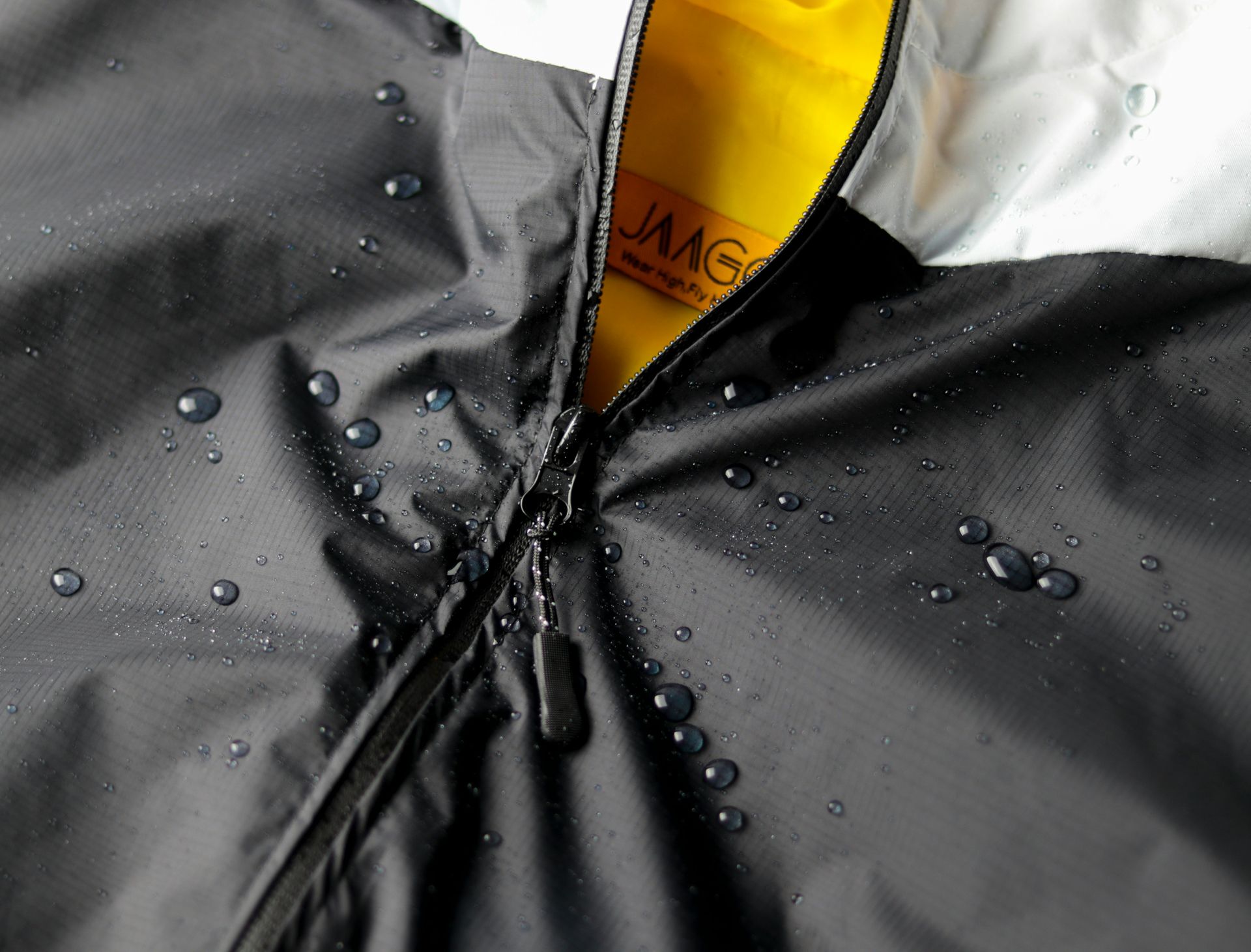
Most outerwear, including all waterproof/breathable rain jackets, have an added durable water repellent (DWR) finish. If the outer fabric of a jacket is "water repellent", precipitation literally beads up and rolls off. Note that this is not the same as a fabric that is "water resistant", which is a general assessment of the ability to prevent water ingress.
Maintaining the DWR finish, which is often overlooked after purchase, is crucial if you want your high-tech jacket to continue performing its job over time. If the DWR wears off, the surface fabric of a jacket can become wet. The underlying membrane or coating still keeps water out, but the soaked outer fabric slows the escape of sweat vapour to the outside. The clammy lining can even stick to your skin, making it seem as though the jacket is leaking.
The more environmentally friendly DWR finishes that are used today wear out faster than older DWR products. Therefore, regularly reapplying a DWR treatment should be part of your maintenance routine for your rain jacket. When the rain no longer beads or when a wet surface gives you cold spots, it is time for a new treatment.
Rainwear layers
For protection, the membrane or coating of a rain jacket is placed in extra layers. An outer layer is resistant to abrasion and repels rain, while an inner layer protects against body oils and wear from the inside of the jacket.
The three types of construction used in rain jackets are a 2-layer, a 2.5-layer, and a 3-layer design. Here is a brief introduction:
2-layer: The quietest
The membrane or the coating layer is applied in an outer layer of fabric, thus forming a single unit. Inside, a loose lining is added to protect the membrane or the coating. Because it is quieter (less "flapping" when you walk), a 2-layer construction is preferred for rain jackets for urban and travel use. Regardless of the use, this design can be found in moderately priced jackets.

2.5-layer: The lightest
Here the term "lightest" can be confusing. Like 2-layer and 3-layer constructions, this design uses a lightweight yet durable outer fabric as the first layer. The second layer is actually a polyurethane laminate or coating that is applied within that first layer. Finally, a protective sheen or print (a half layer) is applied over that second layer.
Although 2.5-layer designs usually do not match the breathability or durability of other jackets, a rain jacket made this way is typically lighter and more affordable. Some wearers find 2.5-layer jackets feel clammy, but jackets with a "dry-touch" print that prevents the jacket from sticking completely to the skin can make a difference.

3-layer: The most robust
No coatings are used here, only a membrane that is tightly sandwiched between a sturdy outer fabric and a lining. Generally, 3-layer jackets are the most durable and breathable construction and are used in rain jackets for the harshest conditions in nature. These jackets are also more expensive.
The following table provides a rough assessment of performance, weight, and price, although some products will be exceptions to these guidelines.
Because the construction requires so many seams, a proper raincoat must be fully taped at the seams to be completely waterproof. Since all waterproof jackets are made this way, you do not need to consider seam tape in your purchasing decision.
However, do not assume that a jacket is completely waterproof just because there is seam tape in the hood and shoulders: this is a common practice with merely water-resistant jackets. Also, do not assume that the absence of seam tape indicates poor quality of a softshell or other water-resistant jacket: seam tape is not used because it would only add complexity that is unnecessary for the intended use.
Zippers
From the opening at the front to the pockets and "pit zips" (zips under the armpits), most jackets are full of zips. To prevent water from seeping through the zips, a rubber coating or a storm flap is necessary. Coated zips, also known as laminated zips, are more difficult to zip open and closed. They also require a cover, often referred to as a zip garage, to shield the small opening at the end of the zip track. Zips make your jacket significantly heavier and you will find few in ultra-light rain jackets.
Hood design
Most hoods have edges and adjustment options on the sides and back to refine the size of the opening. Jackets without these adjustments are intended for more casual use. A hood on a rain jacket from an outdoor brand is usually large enough to fit a climbing helmet underneath.
Ventilation openings
Because even the most breathable rain jacket can become overwhelmed during heavy exertion, almost every outdoor rain jacket has pit zips (ventilation openings under the arms). Some jackets go a step further and have mesh linings in the chest pockets that can serve as additional ventilation openings.
Adjustment options
In addition to the adjustment options for the hood mentioned above, jackets often also have a drawstring at the bottom. Longer jackets may have a drawstring at the waist. Most technical rain jackets also feature adjustable wrist closures. With all these adjustments, you can create tight closures to prevent rain, wind, and cold from sneaking into the openings of your jacket. The adjustments can also be loosened to improve the ventilation of the jacket.
Pockets
Pockets, especially if they are waterproof, increase the price of a jacket. Some jackets have so many pockets that you might be inclined to forget your backpack. Other jackets have hand pockets that are placed above the hip belt and not at the shoulder straps, allowing you to access them while wearing a backpack.
Packability
Ultra-light and not too thick fabric makes a jacket always easier to pack. Some jackets go even further and have a pocket that can also serve as a storage pouch. If a jacket has this feature or has its own storage pouch, it is referred to as "packable".
I personally always roll my jacket up to the hood and then fold the hood over the rolled-up jacket. It works perfectly and fits much more easily in your backpack.