
The Greenland ice sheet is the largest ice mass in the world after Antarctica. It covers around eighty per cent of Greenland and is nearly three kilometres thick in the middle. So there is more ice beneath your feet than there is air above most mountains.
A coast to coast crossing means thirty days in a landscape where there is nothing. No rock, no plant, no animal, no other person. This article is about what that actually involves.
The pulka is the expedition
You do not carry a pack, you pull a sled. A pulka with everything in it: tent, fuel, food for a month, spare equipment. At the start it weighs tens of kilos, and every day it gets a little lighter as you burn through the fuel and the food.
That fact sets the whole rhythm of the expedition. The first week is the hardest, exactly when your body has not yet adapted. From the second half it runs easier, even though you are more tired.
You travel on skis, because walking in that snow with a full sled behind you does not work. It is repetitive work: hours of the same thing, at a pace you cannot push because you have a month to sustain.
Sastrugi
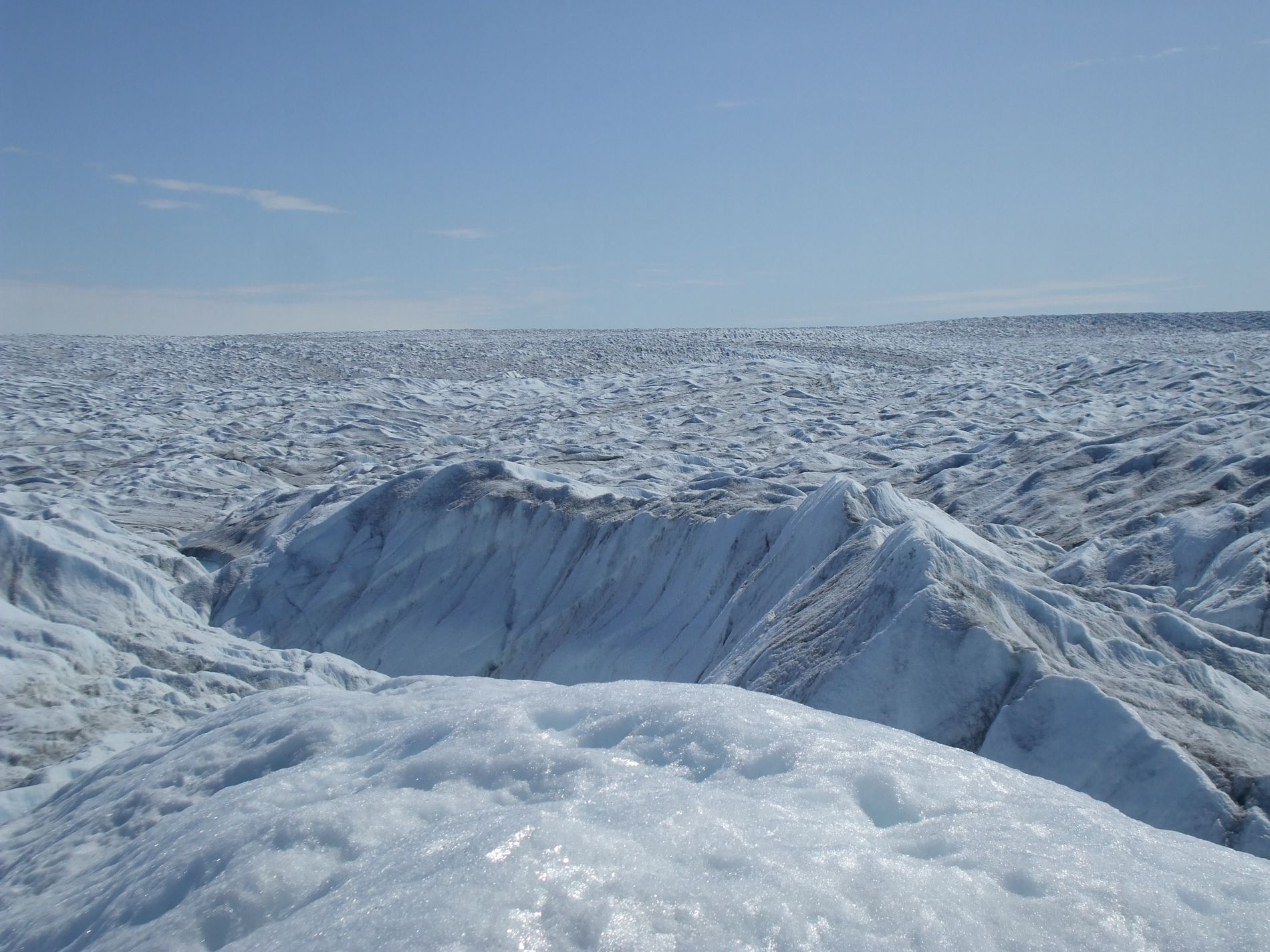
From a distance the ice sheet looks flat. It is not.
The wind sculpts the snow into sastrugi: hard ridges and ribs all pointing the same way, sometimes knee high. They are rock hard, they run across your line of travel if you are unlucky, and your sled constantly catches on them or tips over them.
On a map a day across the ice sheet is a straight line. In practice it is hours of manoeuvring over a surface that works against you the whole time. Sastrugi are the reason distances on the ice sheet take longer than anyone estimates beforehand.
The wind always comes off the ice sheet
Above the ice sheet the air cools and grows heavier, and heavy air sinks. Towards the edges it rolls downhill under its own weight, and it accelerates. That is called katabatic wind, and in Greenland it is a constant.
In practice it means that as you approach the coast you almost always have a headwind, at exactly the point where you are tired and think it is nearly over. It changes camping too: you build a snow wall on the windward side as standard, every evening, even when it is still when you stop.
After two weeks of white there is nothing left to hang your attention on. That is the hardest part, and it is also why people do this. Those who come through it find a calm they struggle to explain afterwards.
Koen De Leeuw, expedition leader
Whiteout
Under cloud the difference between snow and sky disappears entirely. There is no shadow, no horizon and no depth. You cannot see whether the ground ahead rises or drops away, and you trip over ridges you only feel.
Navigation then runs on compass and GPS, and you travel on a bearing without ever seeing anything to aim at. Some participants find that the most unpleasant part of the whole expedition: hours of moving through what feels like empty space, with no evidence that you are getting anywhere.
Altitude where you do not expect it
What people rarely realise: the middle of the ice sheet lies above two thousand metres. You climb gradually from the coast, over days, without it ever being steep.
You do feel that altitude. Combined with cold and daily effort it means you sleep less well and recover more slowly than you are used to. It is not a high altitude mountain, but it is not sea level either.
What emptiness does to a person
This is why people do this crossing, and it is the hardest part to explain.
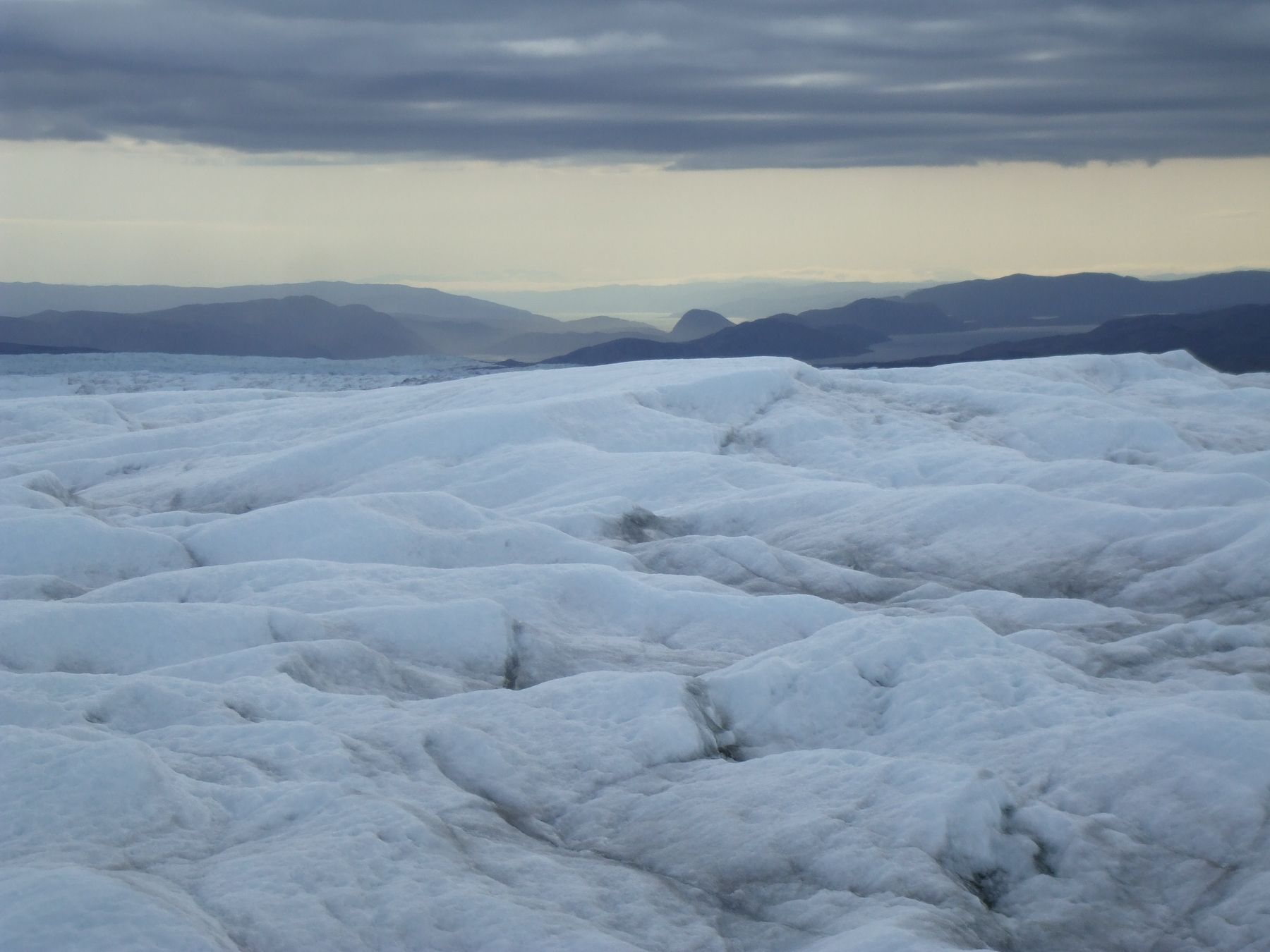
On most expeditions there is variation: a pass, a valley, a village, an animal. On the ice sheet there is exactly the same thing for thirty days. White, in every direction, every day.
The first week that is impressive. The second week it gets hard, because there is nothing to hang your attention on and your mind falls back on itself. And somewhere in the third week it turns over for most people: the search for stimulation stops, and what remains is a calm participants can barely describe afterwards.
That is not guaranteed and it is not for everyone. But it is the reason an ice sheet crossing is something other than a long walk.
Where the mind gives up before the body
The crossing is rated Challenge (4 out of 5) and lasts thirty days, entirely self sufficient. No resupply, no way to step off, no village along the route.
Technically it is not difficult: there is no climbing. What it asks is endurance over a month, experience of camping in cold, and above all mental resilience. This is the destination where the mind gives up before the body does.
And it asks for a group that gets along. Thirty days with the same people in a tent, without distraction, exposes every bit of friction.
Practical
The Crossing Greenland expedition is planned for 2028 and lasts thirty days, coast to coast by pulka. All the details are on the page for the Crossing Greenland expedition.
Want to see the destinations side by side: which expedition suits you compares them on terrain and intensity. And the packing list for an expedition goes into detail on what has to come along.