
Spitsbergen lies at around 78 degrees north, well above the Arctic Circle and closer to the North Pole than to Oslo. That figure means little until you realise what it entails: no trees, no roads outside the settlements, no night in summer, and a landscape where you are not at the top of the food chain.
This article is about what that destination really is, and why packrafts make more difference there than anywhere else.
A landscape without anything vertical
The first thing you notice is what is missing. Not a single tree grows on Spitsbergen. The climate and the permafrost allow only low growing species: moss, lichen, grass and polar willow that creeps along the ground rather than upwards.
That has practical consequences. There is no wood, so no fire and no material to build anything with. There is no shelter from the wind, because nothing stands to break it. Everything you need you carry with you, fuel included.
And it does something to your sense of distance. With no trees or buildings as a reference, everyone misjudges. A hill that looks half an hour away takes two.
Why packrafts make the difference here
Spitsbergen is deeply cut by fjords. On foot that means constantly going around: a fjord two kilometres wide costs you two days if you have to walk around it.
A packraft of a few kilos out of your pack changes the map. You cross where the line makes sense rather than where the land happens to continue. That is not just faster, it makes routes possible that otherwise simply do not exist.
The water is polar water though, at temperatures around freezing. A crossing there is not relaxation but a calculated act: you pick your moment on wind and tide, and you do not paddle when it does not add up.
The polar bear is not an anecdote
Polar bears live on Spitsbergen, and that is not brochure folklore. Outside the settlements, Svalbard law requires you to carry means of protection.
In practice you rarely see one. But it does change how a camp works. You set a perimeter around the tents, there is a watch through the night, and food is never stored where people sleep. That is routine, not drama.
What it does to a group is subtler and more interesting. You are constantly a little more alert than you are used to being. For most people, after a few days that is not tiring but clarifying: it is the first time in years their attention has been entirely on their surroundings.
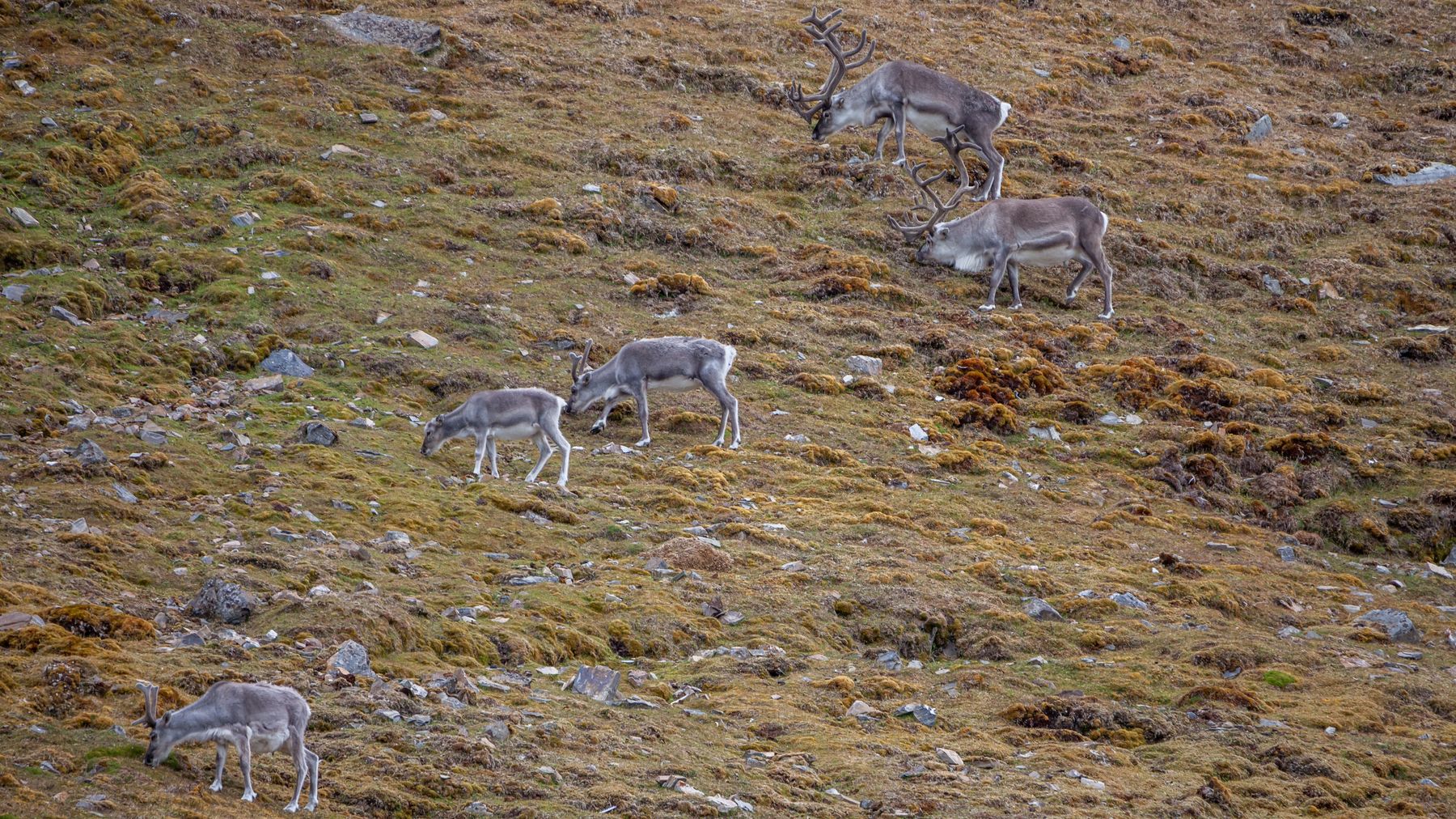
Alongside polar bears there are arctic foxes, walruses, enormous seabird colonies on the cliffs, and the Svalbard reindeer, a stocky subspecies found nowhere else.
Food never goes into your tent. Not because we expect a bear, but because your behaviour has to be consistent on the day there is one. Discipline on day one is what protects you later.
Koen De Leeuw, expedition leader
The midnight sun
From late April to late August the sun does not set on Spitsbergen. There is no dusk and no night, only a sun that circles low over the horizon.
Practically that is an enormous advantage. You are never bound by daylight, you can walk when the weather allows and rest when it does not. A crossing at two in the morning, once the wind has dropped, is simply a good decision.
But the light wrecks your sleep rhythm. Without darkness your body loses its cue, and most participants sleep badly the first few nights. That is no small thing on an expedition where you need your energy every day.
Set against that, the landscape lies for hours in low, warm light. It is one of the few places where at any hour you get the light that elsewhere exists only at sunrise.
Summer is relative
In the Spitsbergen summer, temperatures typically hover a few degrees above zero. That sounds mild compared to a polar winter, and it is.
What makes it difficult is the combination: cold enough to risk hypothermia, wet enough to keep everything damp, and with wind and fog that come up without warning. Wet and three degrees is objectively more dangerous than dry and minus twenty, and that is one of the first things participants learn here.
Ten days entirely off grid
Spitsbergen is rated Challenge (4 out of 5) and lasts ten days, entirely off grid. No lodges, no resupply along the way, no village to fall back on.
You need no technical experience, but you do need good fitness and the willingness to live entirely self sufficiently for ten days in an environment that forgives nothing and offers nothing. It is not a destination where you can sit a day out.
Practical
The Spitsbergen expedition is planned for 2028 and lasts ten days, on foot and by packraft through fjords and tundra. All the details are on the page for the Spitsbergen expedition.
Want to see the destinations side by side: which expedition suits you compares them on terrain and intensity. And the packing list for an expedition goes into detail on what has to come along.