
There is a difference between cold weather and real cold. Cold weather is something you put a jacket on for. Real cold changes everything: how you move, how you eat, how long you can stand still, how you sleep. Above the Arctic Circle in Arctic Lapland, winter is not a season that happens to you, it is the environment itself. Everything you do is about staying warm.
This article is about what that destination actually is in the polar winter: the terrain, the temperature, the reason you go at the end of February and not in January, and what it asks of your body and your mind.
The terrain: taiga, frozen lakes and open fjell
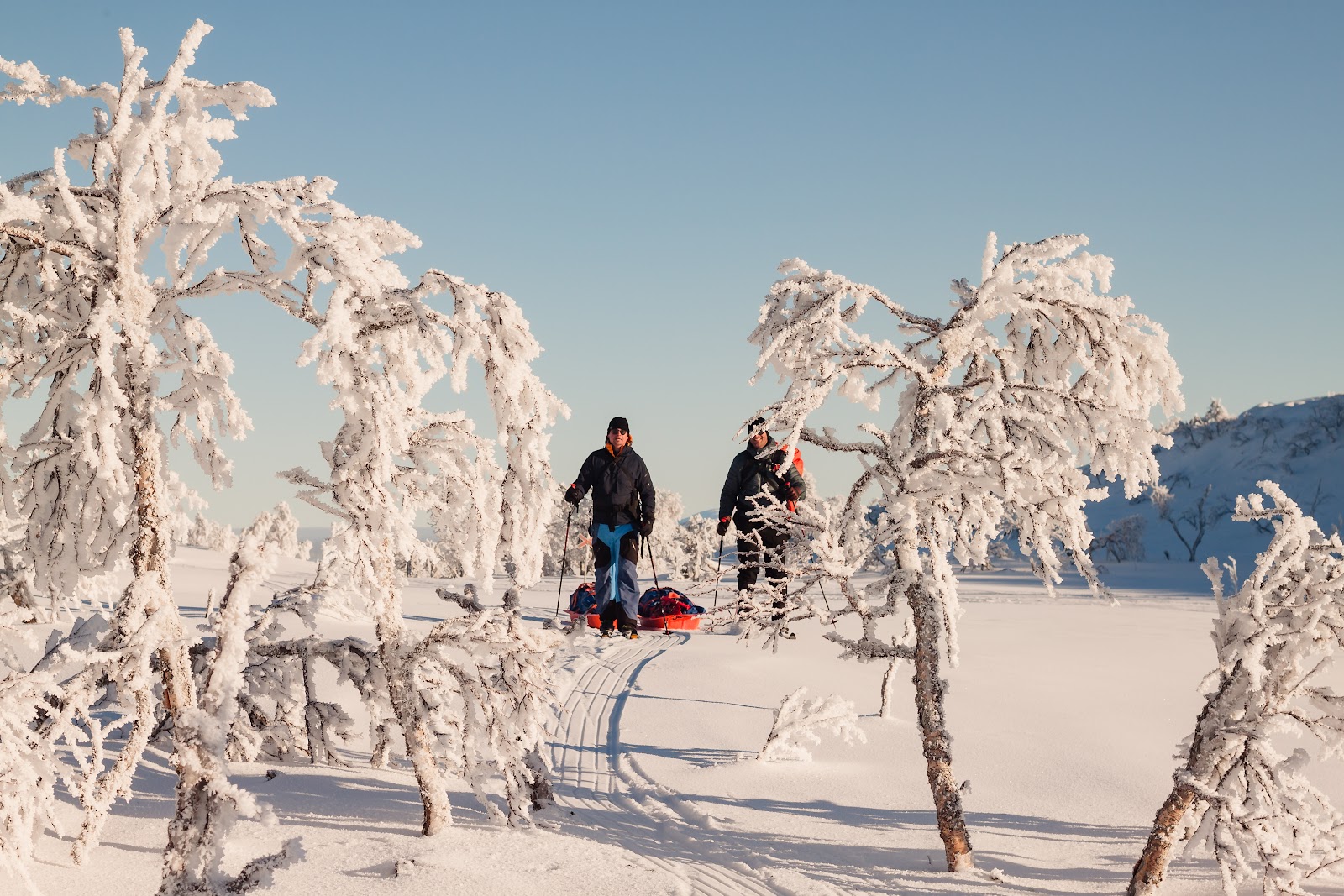
Arctic Lapland is not an alpine destination. You do not climb here, you cross. The landscape consists of three kinds of terrain, each setting a different pace.
The taiga. Coniferous forest of spruce and pine, heavily loaded with snow. In the forest the snow lies deeper and looser because the wind cannot reach it. Without snowshoes you sink to your hips. With snowshoes you make progress, but slowly: the forest demands constant navigation between trunks, and visibility rarely reaches beyond a hundred metres.
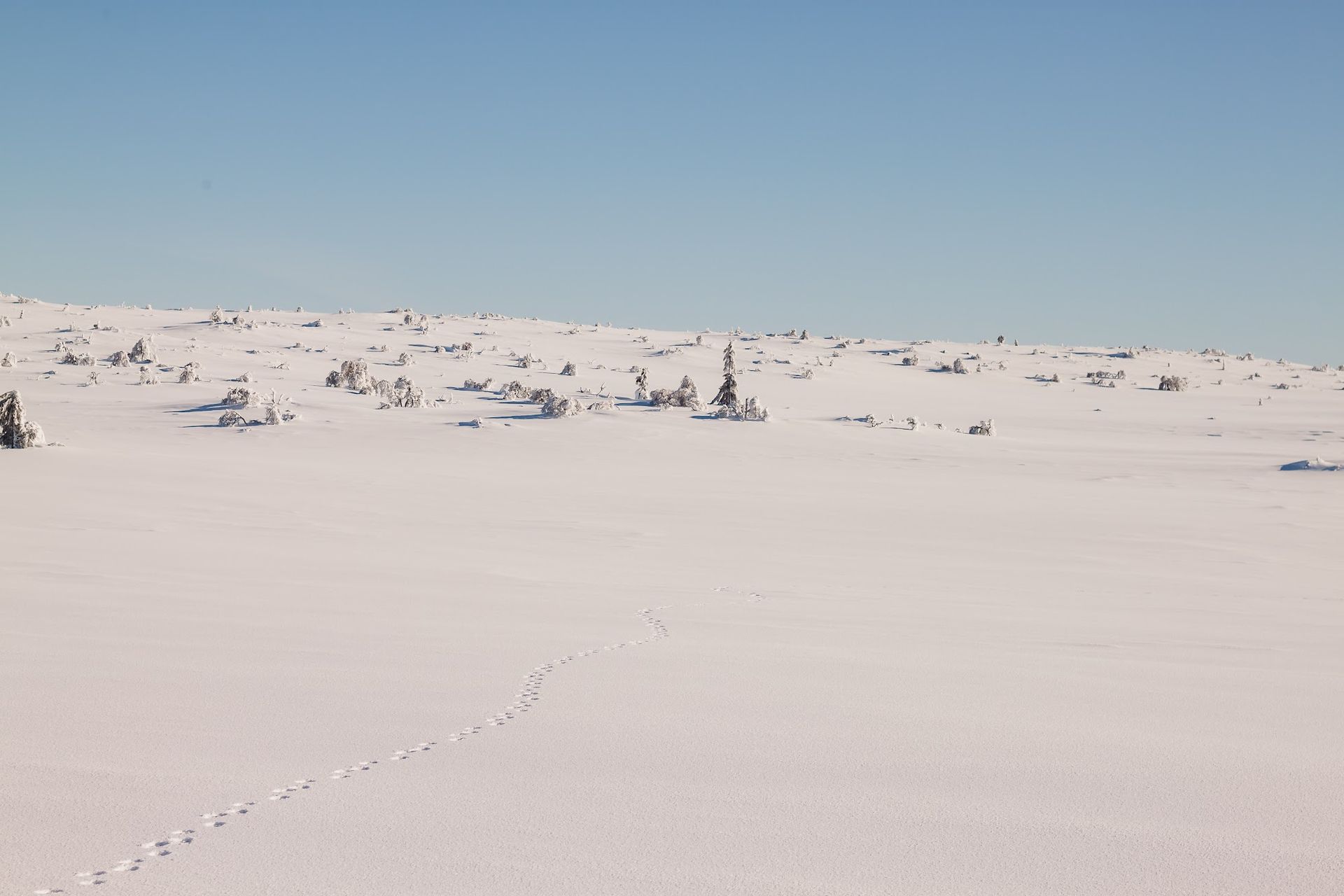
The frozen lakes. Lapland is full of lakes, and in winter they are the motorways. The ice carries, the wind has blown the snow hard, and you can walk in a straight line for hours. It is also where you feel smallest: a white plain without reference points, with a treeline that does not seem to come any closer for hours.
The open fjell. Above the treeline, shelter disappears entirely. Here the wind decides whether a day is comfortable or hard. The same temperature feels twenty degrees colder on the fjell than in the forest.
What the cold actually does to you
At the end of February, temperatures in Arctic Lapland typically range between minus 10 and minus 30 degrees. What those numbers do not tell you is how the cold rewrites your day.
Not sweating becomes a goal in itself. Sweat that stays in your clothing turns to ice the moment you stand still, and that ice costs you more warmth than the wind does. So you deliberately walk underdressed, you leave zips open on the climb and close them at the break. Clothing becomes an instrument you adjust all day long.
You eat more than you are used to, and fattier. In the cold your body burns considerably more energy than it would for the same effort in summer.
And your hands become your weak point. Every task that requires precision, a zip, a buckle, a stove, you do with bare or thin gloves. It is those thirty seconds that count. Anyone whose system is not in order loses warmth again and again to small tasks.
Sleeping in the snow
Snow insulates. That sounds contradictory, but a snow cave or quinzhee stays around freezing point inside while it is minus 25 outside. No wind, no radiation into a clear sky, only the warmth of your own body staying in the space.
Digging such a shelter yourself is one of the most concrete things you learn in a polar winter. It takes hours and it is hard work, at exactly the point in the day when you are tired. But it changes your relationship with the landscape: snow is no longer the problem, snow is the material.
Set off with cold fingers. It sounds contradictory, but dress too warmly in the morning and you are sweating within half an hour, and that sweat turns to ice the moment we stop. Hands warm up from walking. Wet base layers stay wet all day.
Koen De Leeuw, expedition leader
Why the end of February and not deeper into winter
In December and early January it is polar night above the Arctic Circle. Beautiful to see, but unworkable for an expedition covering terrain for days on end.
At the end of February and the start of March everything comes together. The light is back, with days that lengthen quickly and a low sun that colours the landscape orange for hours. The snow is at its deepest and has had a whole winter to settle, so the ice on the lakes is thick and reliable. And the temperatures are still fully wintry. You get the real polar winter, with enough daylight to do something with it.
Not technique but cold that never lets up
The Arctic expedition is rated Challenge (4 out of 5) on our intensity scale. Here that rating is not about technical difficulty: you need no climbing experience and there is no rope work.
It is about enduring in conditions that give you no break. Days on snowshoes with a full pack, in cold that never lets up, with nights outside. The exhaustion is not acute but cumulative: day four is harder than day two, even though you cover the same ground.
What you need is reasonable base fitness and the willingness not to treat discomfort as a problem. Those who keep complaining about the cold have a hard time. Those who learn to manage their system discover that minus 25 is simply a condition you can work with.
Practical
The Arctic expedition runs from 27 February to 6 March 2027 and lasts eight days. It includes a helicopter drop into the backcountry, crossings over frozen lakes and building snow shelters. Guiding, group equipment and the winter gear you do not have to buy yourself are all included.
Still unsure about the destination: in which expedition suits you we set the destinations side by side on terrain and intensity. And for anyone wondering what goes into an expedition pack: the packing list for an expedition covers that in detail.