
An ice bath is not a contest in gritting your teeth. It is an exercise in staying calm while your body goes into alarm. Learn that under guidance and you discover something that reaches beyond the tub: you can use your breathing to steer your response to stress.
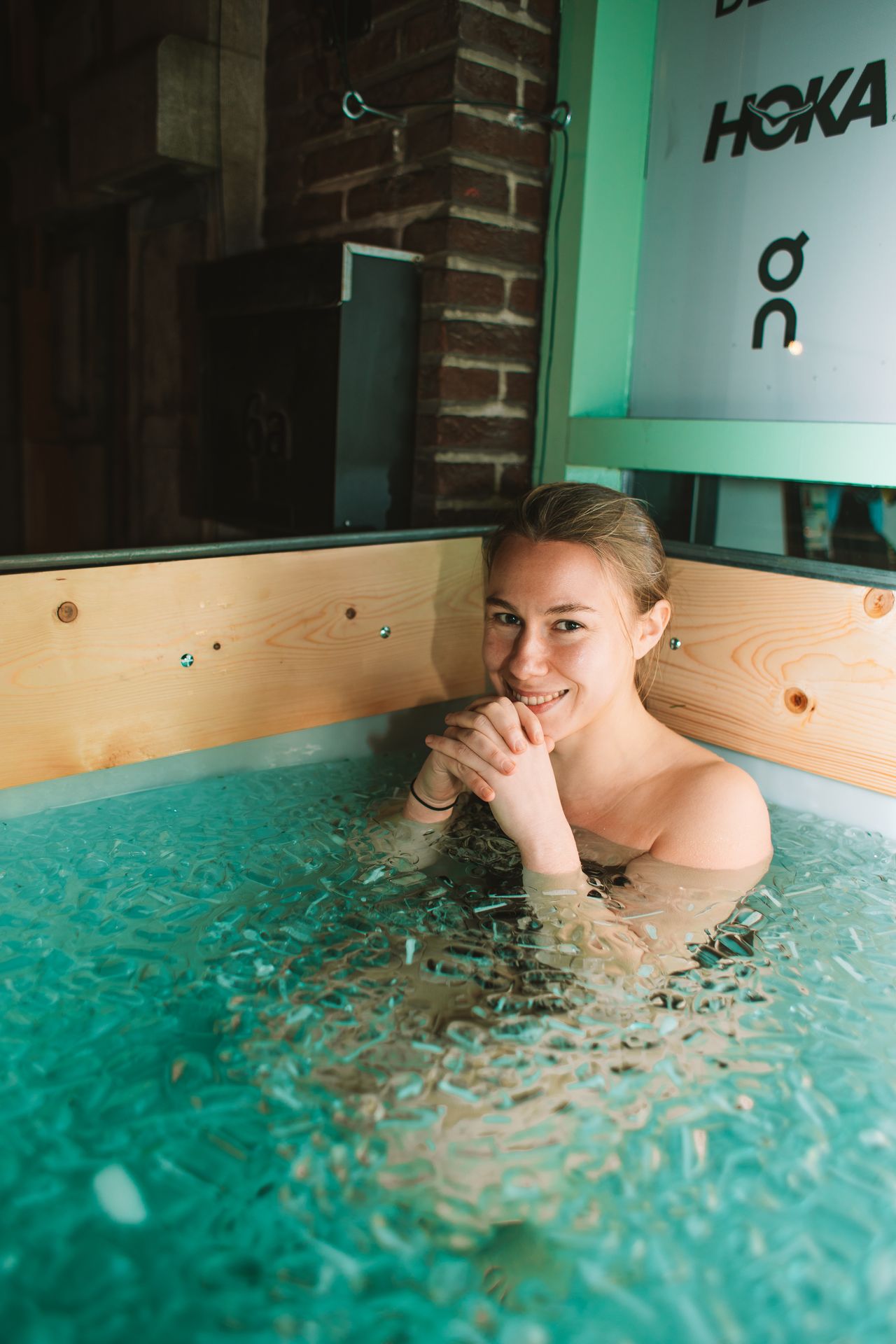
What cold does to your body
The moment you step into water of four to ten degrees, three things happen at once.
The cold shock response
The first thirty to sixty seconds are the most dangerous. You gasp involuntarily, your breathing speeds up and your heart rate jumps. This is the reflex people drown from in open water, not hypothermia. Learning to breathe calmly through that first minute is the core of any good introduction.
Vasoconstriction
The blood vessels in your arms and legs clamp shut to keep heat around your organs. Your hands and feet turn white and numb. That is functional, not damage, as long as the exposure stays short.
A hormonal surge
Šrámek and colleagues (2000) measured a rise in noradrenaline of several hundred percent during immersion in cold water. That explains the sharpness and the energy many people describe afterwards.
What the research does and does not show
Big claims circulate about cold. The honest picture is more nuanced.
The best known study comes from Kox and colleagues (2014, PNAS). They trained a group of volunteers in breathing and cold exposure and then administered a bacterial endotoxin. The trained group produced more adrenaline and showed a markedly weaker inflammatory response than the control group. That is a real and replicated result, but it concerns one specific, short lived response, not immunity in general.
Buijze and colleagues (2016, PLoS ONE) had more than three thousand people in the Netherlands take cold showers for thirty days. The cold group reported almost thirty percent fewer days of sickness absence than the control group, while the number of illness episodes itself did not differ. In other words: they did not fall ill less often, they simply kept going more often.
How we read it
Cold mainly trains your ability to stay calm inside an acute stress response. That is exactly the skill you need on expedition. The health effects are real but modest, and none of them is a reason to loosen the safety rules.
Safety: where we do not bend
An ice bath is not for everyone. With heart conditions, high blood pressure, asthma, epilepsy, Raynaud's phenomenon or pregnancy we advise against taking part. If you are unsure, ask your doctor and let us know before you start.
- A guide is always present, even with experienced participants.
- You never enter the water alone, and never open water without supervision.
- No alcohol beforehand, and not straight after a heavy meal.
- Your head stays above water. We do not dive or submerge the head.
- If you feel unwell, you stop. No discussion.
How we build it up
1. Breathing first
Before you touch the water we practise a calm breathing rhythm with a lengthened exhale. If you can exhale, you can ride out the cold shock.
2. Short and controlled
The first time you stay in the water for thirty to sixty seconds. That is enough to get to know the reflex. We build up to three minutes maximum, never longer.
3. Warming up without shortcuts
Afterwards your core temperature keeps falling for a while, the so called afterdrop. That is why you warm up actively with dry clothing, movement and a hot drink. A hot shower or sauna straight after the bath is something we deliberately avoid.
Why this matters on expedition
On a winter expedition cold is not an exercise but an environment. Someone who has learned to steer their breathing when the body panics makes better decisions with a soaked sleeping bag or an unexpected turn in the weather.
Arctic
Eight days in Lapland at minus thirty. See Escape The Arctic.
Carpathians
Wilderness training in the snow, with bivouac and navigation. See the Carpathians.
Practise at home first
Start with cold showers and read how layering works in Layering basics.
Trust in yourself and in the guidance
Pushing your limits only works when the frame is right. We provide the frame, you take the step. That way you step out of the ice bath stronger than you stepped in.
Sources
- Šrámek, P. and colleagues (2000). Human physiological responses to immersion into water of different temperatures. European Journal of Applied Physiology.
- Kox, M. and colleagues (2014). Voluntary activation of the sympathetic nervous system and attenuation of the innate immune response in humans. PNAS.
- Buijze, G.A. and colleagues (2016). The effect of cold showering on health and work: a randomized controlled trial. PLoS ONE.