
There are few places where expectations run as high as in the Khumbu. Everyone has images of it in their head before they even leave. What surprises most people is that it is not empty wilderness: it is an inhabited valley at high altitude, where people have lived, traded and farmed for centuries.
This article is about what that destination really is, why autumn is the window, and what it means to climb a first six thousander there.
High mountains with villages
The Khumbu is the homeland of the Sherpa, a community of Tibetan origin who settled in these valleys centuries ago. You walk past monasteries, prayer walls and fields at altitudes where in the Alps nothing has grown for a long time.
That changes the character of the journey entirely. You sleep in lodges rather than a tent, you eat hot food in a communal room, and there is contact every day with people who live here. Anyone seeking the isolation of Patagonia or the Greenland ice cap should not be in the Khumbu.
What you get in return is something no other destination offers: altitude above five thousand metres without having to be entirely self sufficient, in a landscape that is as impressive culturally as it is geographically.
The terrain climbs in steps
The valley does not rise evenly. It climbs in distinct steps, and each step feels like a different region.
At the bottom it is still green: conifer forest, rhododendron, suspension bridges over deep river gorges. It is warm here and there is oxygen in the air.
In the middle lies the heart of the Sherpa community, at around three thousand four hundred metres. This is where everyone stays a few days to acclimatise, and where you first notice that walking up a flight of stairs leaves you out of breath.
At the top the vegetation disappears. Moraine, boulders, glacial debris and yaks carrying loads. The air is sharp and dry, and at night it always freezes.
Why autumn
Nepal has two climbing seasons, and they are not equivalent.
Spring is the season of the big Everest expeditions. It is busier, and the air is often hazy as dust and smoke drift up from the lowlands.
Autumn comes just after the monsoon. It has washed the atmosphere clean, and that produces the clearest skies of the year: days when you can see a hundred kilometres from a pass. The weather is also steadier than in spring, with less afternoon cloud. Against that, it grows colder as the season goes on.
For an expedition where the view of the surrounding peaks is part of the experience, that choice is not a difficult one.
The acclimatisation days are the expedition, not the warm up. I would rather have someone with average fitness and patience than an athlete who keeps quiet about a headache.
Koen De Leeuw, expedition leader
A six thousander is a different sport from trekking
The trek and the climb are two different things, and that distinction matters.
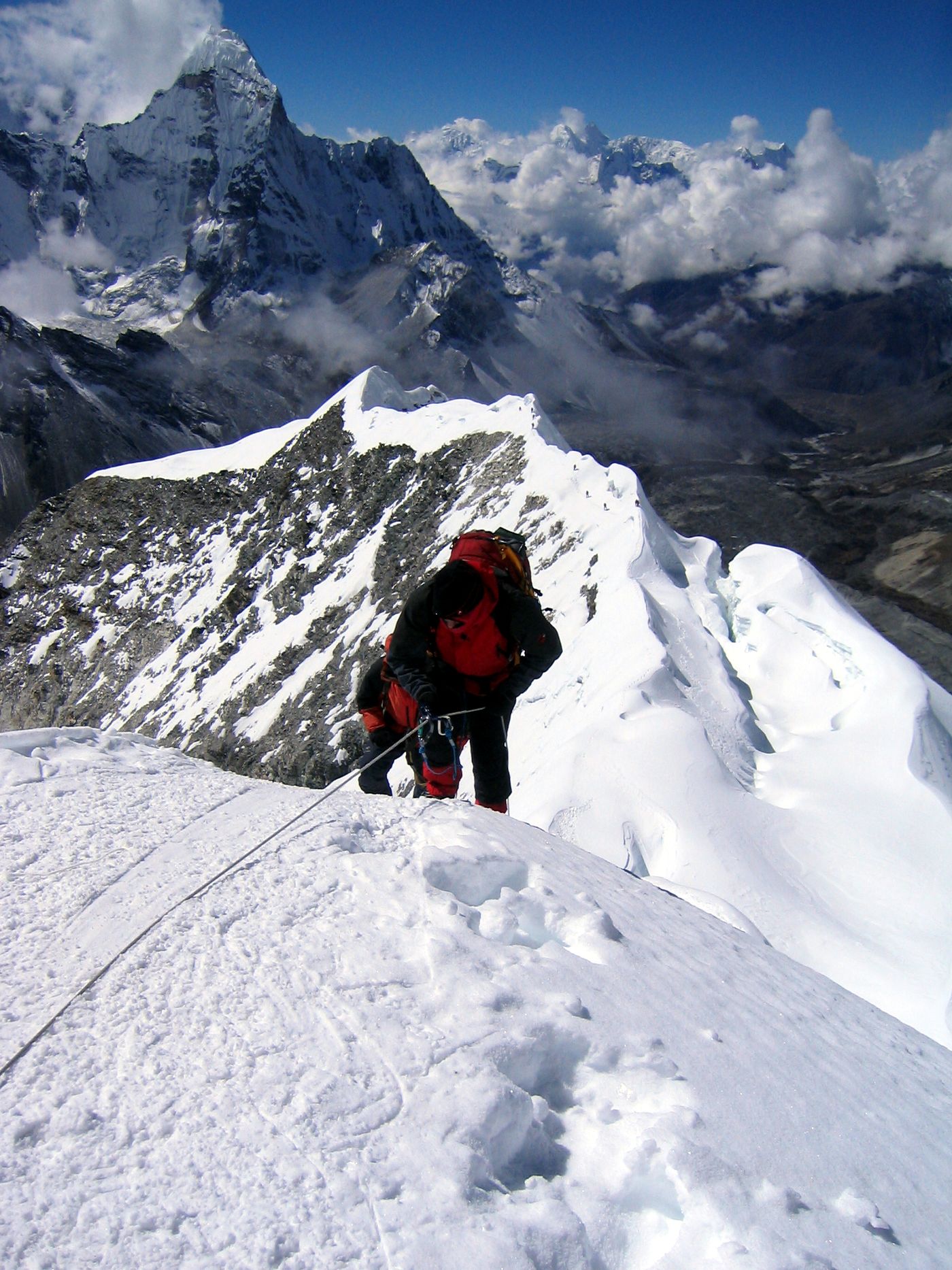
Trekking through the Khumbu is walking. Hard because of the altitude, but technically simple. Climbing a six thousander means getting onto glacier terrain: crampons, rope, an ice axe, and on steeper sections fixed lines you work your way up with an ascender.
You learn those techniques on site, and that is one of the reasons this destination is the logical first high altitude climb for many people. You build altitude over sixteen days, you learn the technique in the area itself, and the summit is an achievable goal rather than a gamble.
What it really asks is the willingness to set off at two in the morning on summit day and climb for hours in the dark, at an altitude where nothing comes easily any more.
Why acclimatisation days weigh just as heavily
The Himalaya expedition is rated Challenge (4 out of 5) and lasts sixteen days. You need no mountaineering experience, but you do need strong base fitness and the patience for a programme in which the acclimatisation days matter as much as the climbing days.
Altitude remains the deciding factor. Even with a well built schedule there is no guarantee your body will cooperate, and the decision to keep someone lower rests with the guide. Anyone who accepts that in advance has the right attitude for this mountain.
Practical
The Himalaya expedition departs in the autumn of 2027 and lasts sixteen days: a trek through the Khumbu and the ascent of a six thousander. All the details are on the page for the Himalaya expedition.
Want to see the destinations side by side: which expedition suits you compares them on terrain and intensity. And the packing list for an expedition goes into detail on what has to come along.